Case study
Kindred Tales
AI-assisted memoir service that turns a parent's or grandparent's life stories into a hardcover book.
- My role
- Founder. Product, design, AI plumbing, ops, GTM.
- Timeframe
- Mar 2022 to present
- Built with
- Live at
- kindredtales.net
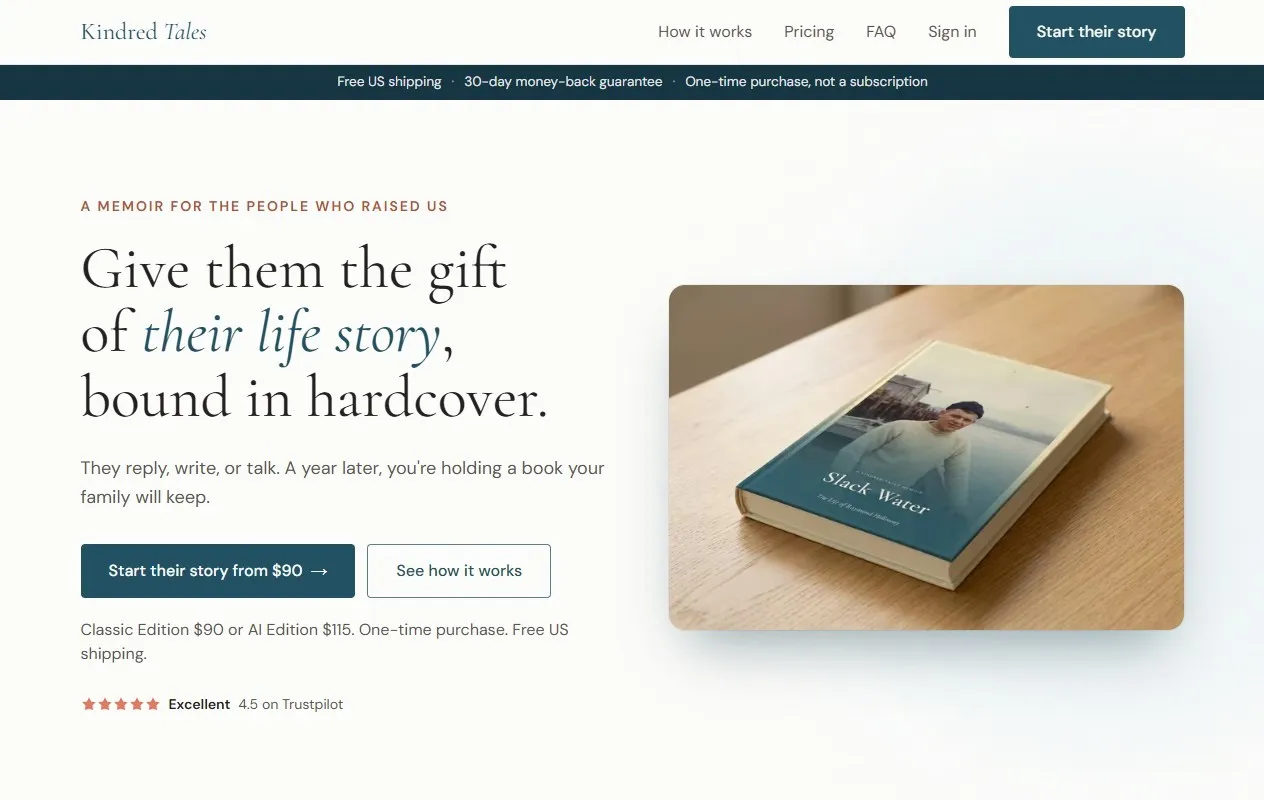
A daughter buys the gift in November. By February, her dad has talked through seven chapters with Ali, our AI biographer. By June, the book is in her mom’s hands at the kitchen table.
That’s the whole product in three sentences. Everything else is plumbing.
The problem
Most people mean to write down their parents’ stories. Almost nobody does. The tools that exist assume the wrong person does the work. They hand a blank document to a busy 40-year-old, or a recording app to an 80-year-old who doesn’t want a recording app.
Kindred Tales flips it. The buyer is usually an adult child or grandchild. The storyteller is usually 50 or older, and sometimes tech-averse. So the job was never “build a memoir app.” It was “make it possible for someone who will not learn new software to answer questions for a year, and turn that into a real book.” A 400-page hardcover, one-time purchase, no subscription.
What I built
I built Kindred Tales end to end. Product, design, the AI systems, ops, and go-to-market. All while holding a product leadership role at Thomson Reuters.
The part I’m proudest of isn’t a model. It’s the harness around the models. An AI harness is everything that isn’t the model itself: the context you feed it, the prompt structure, the workflows, storage, error states, and the customer experience that hides all of it. Four of those run in production.
Ali, the AI biographer. A guided interviewer built on an LLM plus speech-to-text. Ali isn’t a chatbot bolted to a homepage. It carries the storyteller’s prior chapters as context, follows an interview structure built to pull specific memories instead of generic ones, and drafts chapter text in the storyteller’s own voice. Five ways in: reply to an email, type it, chat with Ali, record your voice, or upload audio. The email path exists because the most important user won’t log in.
The transcription workflow. Audio in, structured chapters out. Live recording or an uploaded file moves through capture, transcription, storage, database updates, status in the UI, error states, and cleanup. The real work is in the unglamorous parts: what happens when the upload dies halfway, or when the file is 40 minutes of a grandfather talking over a TV.
The book generation server. My most mature system, and the one with no LLM in it at all. Structured JSON goes in. A Java service resolves it against templates, fonts, image placement rules, cover metadata, and the print shop’s constraints, and a print-ready hardcover PDF comes out. It’s an agent loop in the deterministic sense: defined inputs, defined transformations, a finished artifact every time. It taught me more about “agentic” thinking than any LLM project has.
The cover builder. Editor choices plus template logic plus positioning and rendering rules, resolved into a real cover preview. Smaller, but it’s the moment the gift becomes real to the buyer, so it earns its complexity.
Try the Ali walkthrough
This is a scripted walkthrough of an Ali interview. The conversation is pre-written. No model is called and nothing is recorded.
Scripted walkthrough. Pre-written example, no live AI.
What worked
Kindred Tales is a revenue-generating business. People pay for it, storytellers answer the questions, and hardcover books get printed and shipped. I’m keeping the specific numbers off this page for now.
The design bet I’d make again is building for the least technical person in the transaction. Email is one of five ways in because the storyteller may never log in at all. I haven’t published data comparing the five paths, so read that as a design principle and not a measured result.
What I’d redo
I started on Bubble. It got the product to real customers fast, and I’d make that call again at the start. But I outgrew it. I’ve been replacing it in phases with React and TypeScript, Node, and Postgres on Google Cloud. Phased on purpose. A business with books in production can’t stop taking orders while the platform changes underneath it, so pieces move one at a time instead of in one big cutover.
If I were starting over, I’d build the transcription and PDF harnesses first and the marketing site second. The systems were the moat. The site was replaceable.
What it taught me about AI in production
One business, n of 1. Take it as that. Two things held up.
The model is the cheap part. The expensive part is everything around it: the retry when the API times out, the formatting when a transcript runs long, the email that fires when a chapter is ready. Demos live in the model. Products live in the harness.
And modern tools changed the number of roles one person can hold at once. On Kindred Tales I’m the PM, the designer, most of the engineering, the support inbox, and the marketer. That isn’t a brag about hours. It’s the actual shift worth paying attention to.
Related
- Thomson Reuters. The enterprise side of the same instinct.
- Kindred Tales AI Workforce. The AI agents that do the marketing and ops work behind it.
- See it live at kindredtales.net.